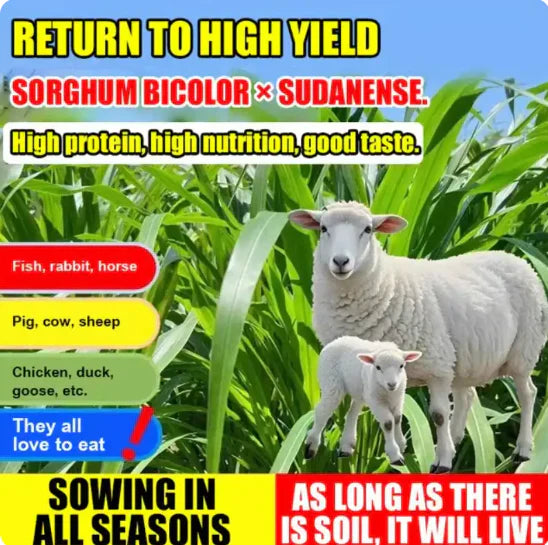
High-Yielding Forage Seed YT
High-Yielding Forage Seed YT
Regular price
79,000 Tsh
Regular price
120,000 Tsh
Sale price
79,000 Tsh
Unit price
per
Shipping calculated at checkout.
🌿Discover the Premium Forage Solution!
Hybrid Sorghum-Sudan Grass King is an exceptional forage variety, expertly combining the beneficial traits of Sorghum bicolor and Sorghum sudanense. This drought-tolerant grass is perfect for feeding cattle, sheep, horses, pigs, and other livestock, adapting beautifully to various environments.

🌱 1. Plant Characteristics
(1) Growth Habits
- Fast Growth: The first harvest can be done 30-45 days after sowing, with 5-8 consecutive harvests possible under optimal conditions.
- Drought and Heat Tolerance: More resistant to dry and hot climates than regular forage grasses, making it suitable for arid and warm regions.
- Strong Regeneration Ability: Rapid regrowth after cutting ensures a continuous supply of forage.
- Pest and Disease Resistance: More resistant to diseases and pests compared to regular Sudan grass.
- Well-Developed Root System: Efficient in absorbing nutrients and water, allowing it to grow even in poor soil.

(2) Nutritional Value
- High Protein Content: Contains 10-14% crude protein in dry matter, which is higher than regular Sudan grass.
- Rich in Energy: Highly palatable, livestock enjoy eating it, which helps increase weight gain and milk production.
- Moderate Fiber Content: Easily digestible, reducing the risk of digestive issues.
- High Sugar Content: Suitable for silage production, enhancing feed preservation and palatability.

🌾 2. Suitable Growing Conditions
Soil Requirements
- Highly adaptable, can grow in sandy, loamy, or clay soils, but thrives best in well-drained, fertile soil.
- Soil pH range: 5.5-7.5, suitable for slightly acidic to neutral soils.

🌍 3. Cultivation and Management
(1) Sowing Methods
- Sowing Season: Spring and summer when the temperature is above 15°C.
- Sowing Techniques:
- Row Planting: 30-40 cm row spacing for better ventilation and sunlight exposure.
- Broadcast Seeding: Suitable for large-scale grazing, requiring a higher seeding rate.
- Seeding Depth: 2-3 cm deep; too shallow may lead to seed washout, while too deep affects germination.
(2) Water and Fertilizer Management
💧 Watering
- Keep soil moist after sowing to aid seed germination.
- Irrigate during droughts to promote regrowth.
- Reduce watering in the later stages to improve silage quality.
🌿 Fertilization
- Apply sufficient base fertilizer (organic or compound fertilizer) to support seedling growth.
- Use nitrogen fertilizer after each harvest to boost protein content and regrowth ability.

🚜 4. Forage Utilization
(1) Harvesting and Grazing
- First Harvest: When plants reach 80-100 cm, maximizing yield and palatability.
- Cutting Height: Leave a 10-15 cm stubble to encourage regrowth.
- Grazing: Best for rotational grazing; forage should be 60-80 cm tall before grazing to prevent livestock damage to roots.
(2) Silage and Hay Production
🥬 Silage
- Harvest at 100-120 cm for optimal sugar content and fermentation.
- Chop into 2-3 cm pieces, compact and seal airtight, ferment for 30-40 days before feeding.
🌞 Hay
- Harvest on sunny days, spread to dry for 2-3 days until the moisture content drops below 15%, ensuring long-term storage.


✅ 5. Suitable For
✔ Livestock Farmers (Reduces feed costs)
✔ Ranch Owners (Boosts pasture productivity and income)
✔ Agricultural Growers (Sell forage or silage feed)
✔ Ecological Restoration Projects (For soil conservation and greening)